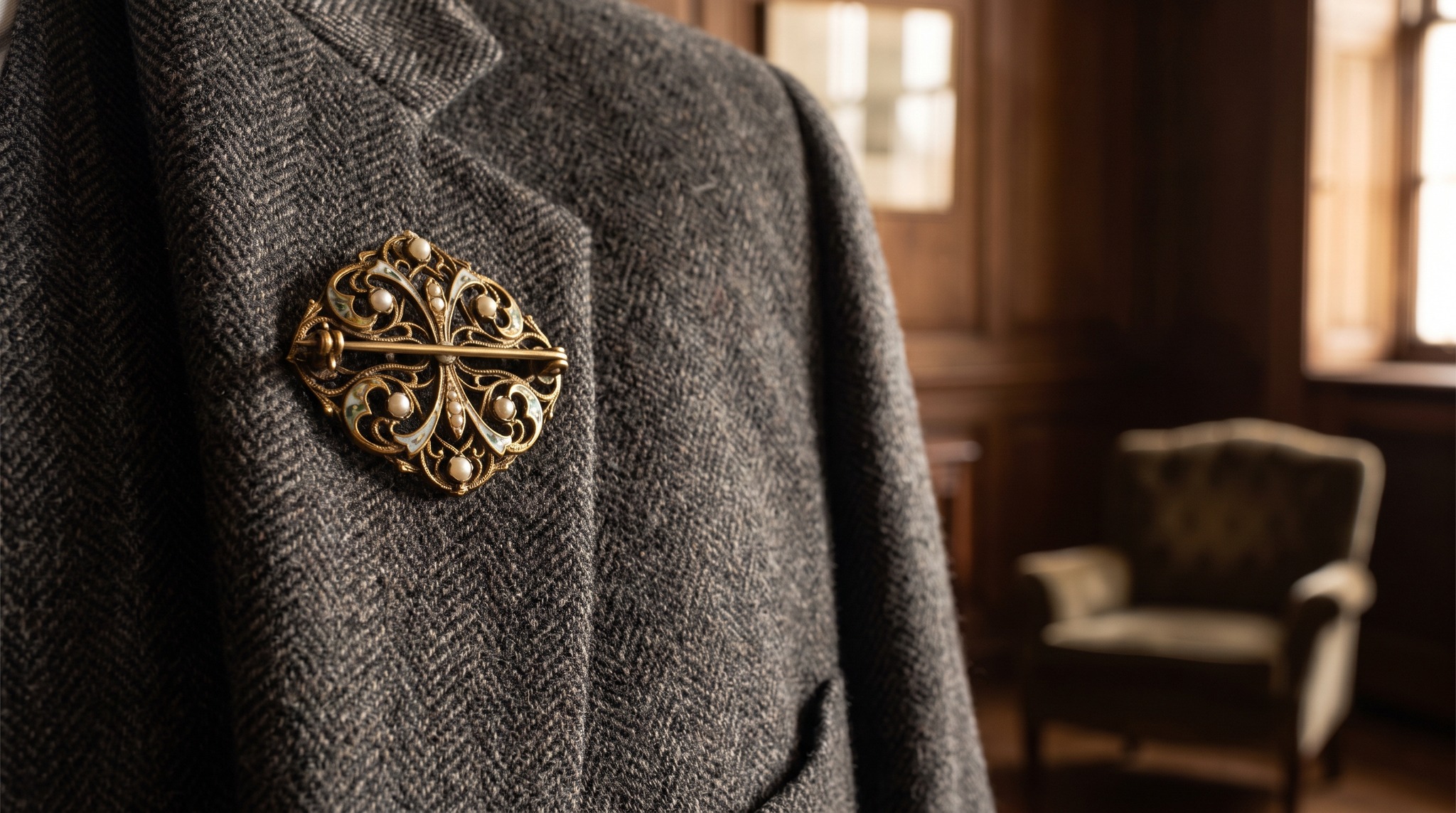
Brooch on the Lapel: Position, Weight, Pin Fastening
A brooch on the lapel adds a personal touch to your jacket or coat and emphasizes your individual style. But where exactly should the piece of jewelry sit, how heavy may it be so the fabric does not stretch out, and which pin fastening prevents you from losing your favorite piece? These questions arise for many who wish to wear a brooch for the first time. Proper handling determines whether the accessory appears elegant or disrupts the look.
The Classic Position on the Lapel
The brooch belongs on the left lapel, approximately at the height of the buttonhole or just above it. On a single-breasted jacket with a pointed lapel, place it about five to eight centimeters below the shoulder seam. On wide, flared lapels from the 1920s and 1930s, it may also sit centrally on the lapel surface. It is important that the brooch is not placed too close to the edge, otherwise the lapel tips forward and loses its shape.
Weight and Fabric Stress
Lightweight brooches up to about 15 grams hardly stress the fabric and are suitable for fine wool fabrics or silk. Heavier pieces from 20 grams should only be attached to robust material such as flannel, tweed, or heavy worsted. With very wide pleated-trouser jackets with sturdy fabric weighing 350 to 400 grams per square meter, more substantial brooches can also be worn. After removal, check whether puncture marks or dents appear in the fabric: then the piece of jewelry was too heavy or the pin too thick.
Pin Fastening: Mechanisms Compared
The simple C-clasp pin slips easily and should only be used with lightweight brooches. More secure is the roll clasp, where a small bracket folds over the pin tip and clicks into place. Most reliable are screw fastenings or double locks with folding bracket plus additional hook. High-quality Jewellery pieces often feature such mechanisms that hold even during movement on stage or while dancing.
Attachment Without Fabric Damage
Always guide the pin diagonally through the fabric, never vertically. This distributes the stress across several fabric threads. Pierce through the upper fabric layer and the underlying interlining, but not through to the lining layer. With double-layer lapel constructions, it suffices to catch both outer layers. Avoid piercing the same spot multiple times: each hole weakens the fabric. Occasionally change the position by a few millimeters so that no permanent puncture marks form.
Combinations with Other Accessories
A brooch pairs well with a pocket square, tie, or bow tie, as long as the proportions are right. Large, striking brooches suit plain ties in subdued colors. Small, discreet pieces harmonize with patterned pocket squares. Never wear more than one brooch on the jacket: this appears overloaded. If you wish to combine several Accessoires, ensure that metal and color tone are coordinated.
Care and Storage
Clean the brooch after each wearing with a soft cloth to remove skin oils and dust. Polish silver-plated or gold-plated surfaces with special care cloths. Store brooches individually in fabric pouches or padded compartments so that pins and fastenings do not scratch. Regularly check the pin fastening: worn-out springs or bent hooks should be renewed by a goldsmith before you lose the piece.
Related items: Ladies Jewelry, Men's Jewelry, Suits. The complete range: Men's Fashion and Accessories.
All Il Padrino Moda news at a glance
Related categories: Ladies Jewelry, Men's Jewelry, Suits. The full range: Men's Fashion and Accessories.
Read more: Suit Trousers Without Belt Loops: Waist Measurement and Fit, Ear Studs or Hoops: Size and Weight for Men, Jewellery on Aeroplanes: Hand Luggage or Worn on the Body, Cap Shape: Flat, Curved or with Button on Top, Women's Jewellery in a Masculine Style: Wearing Chains, Rings and Bangles with Confidence