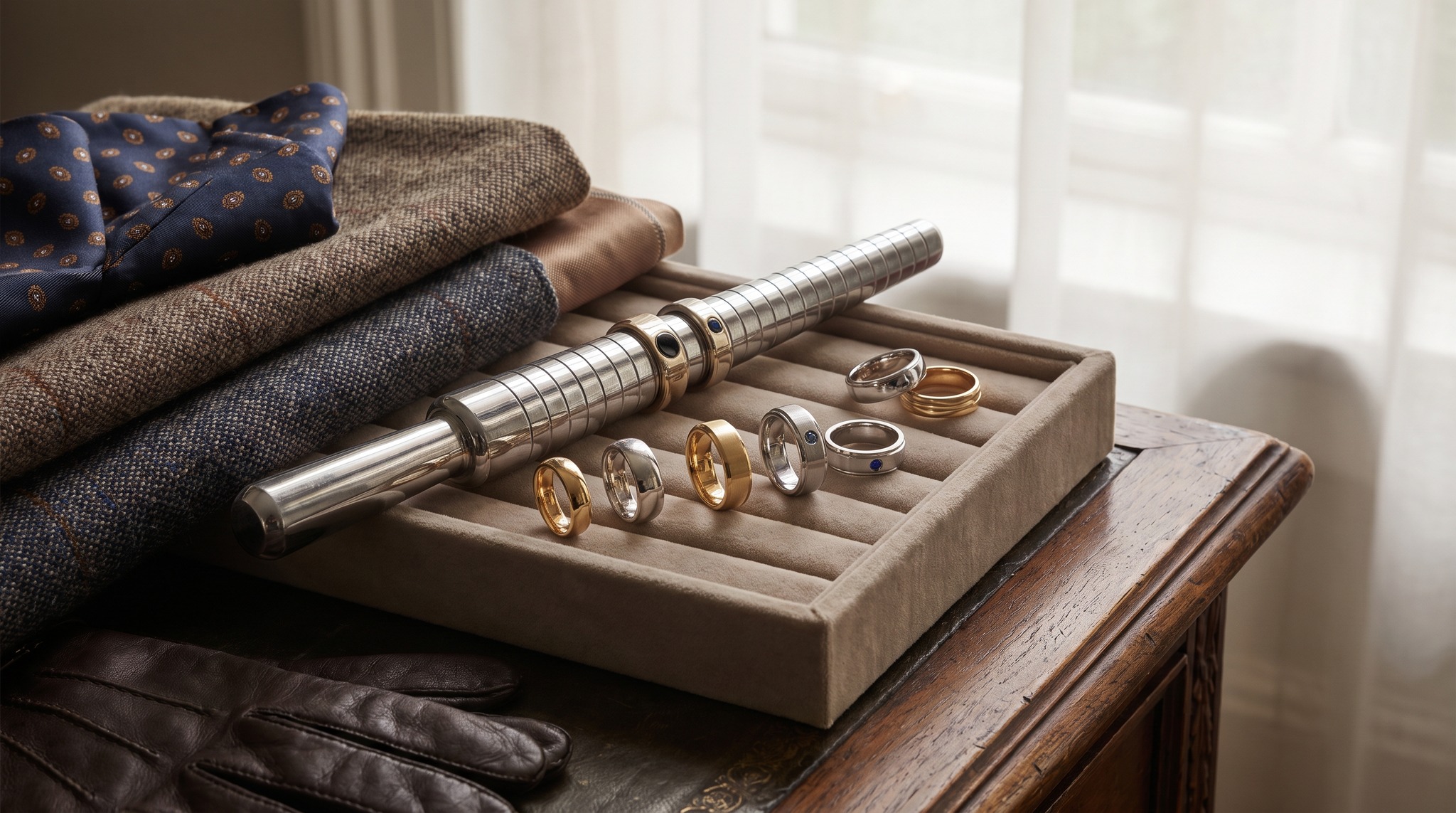
Determining Ring Size: Circumference, Width, Comfortable Fit
You have your eye on a ring, but which size truly fits? A ring that is too tight constricts, while one that is too loose slips or constantly rotates. Particularly with wide statement rings, the correct size is crucial for wearing comfort. We will show you how to determine your ring size precisely and what to consider regarding width and fit.
Measuring Circumference: The Basis of Ring Size
Ring size corresponds to the inner circumference of the ring in millimetres. Measure the circumference of your finger at its widest point, over the knuckle, using a thin strip of paper or thread. Wrap the material once around your finger, mark the overlap, and measure the length with a ruler. The result in millimetres is your ring size: a circumference of 57 mm corresponds to size 57, a circumference of 60 mm to size 60.
Consider Time of Day and Finger Thickness
Fingers swell differently throughout the day. Ideally, measure in the evening when fingers have reached their maximum thickness. Temperature also plays a role: fingers expand in warmth and contract in cold. Therefore, measure at normal room temperature. Repeat the measurement on several days to compensate for fluctuations.
Wide Rings: Choose One Size Larger
The wider a ring, the more contact surface it has with the finger. This means: a wide ring fits more snugly than a narrow one in the same size. As a rule of thumb:
- Rings up to 6 mm width: order measured size
- Rings from 7 to 10 mm width: half a size larger
- Rings over 10 mm width: one full size larger
Particularly with striking Jewellery featuring prominent width, this adjustment is crucial for wearing comfort over hours.
Knuckle Test: The Ring Must Pass Over
A ring must fit over the finger knuckle without pinching. Even if it sits perfectly at the base of the finger: if it cannot be comfortably slipped over the knuckle, it is too small. Test this with an existing ring or simulate the size with a provisional ring made from sturdy paper. The knuckle is usually 1 to 2 mm thicker than the base of the finger.
Measuring an Existing Ring
If you already own a well-fitting ring, measure its inner diameter with a ruler. Multiply the diameter by 3.14 to obtain the circumference and thus the ring size. An inner diameter of 18.5 mm yields approximately 58 mm circumference, therefore size 58. This method is more precise than measuring on the finger and is particularly suitable when you wish to add accessories to existing pieces from your Jewellery collection.
Between Two Sizes: Rather Larger
If you are between two sizes, choose the larger one. A slightly too wide ring can be adjusted with a transparent ring adjuster, while a too tight ring causes pressure marks and is barely wearable. Particularly with rings featuring wide bands or solid designs, freedom of movement is more important than an absolutely firm fit.
Related items: baroque mirrors, Pleated trousers, Accessoires. The complete range: men's fashion and accessories.
All Il Padrino Moda news at a glance
Related categories: baroque mirrors, Pleated trousers, Accessoires. The full range: Men's Fashion and Accessories.
Read more: Adjusting Suspenders: Length, Clips, Buttonholes, Having Pleats Sewn In: When Alterations Are Worth It, Cufflinks, Pocket Square, Chain: How Much Detail Can an Outfit Handle, Arm Jewellery for Men: Pearls, Stone and Metal in 1920s Style, Il Padrino: Why Authority Dresses Quietly