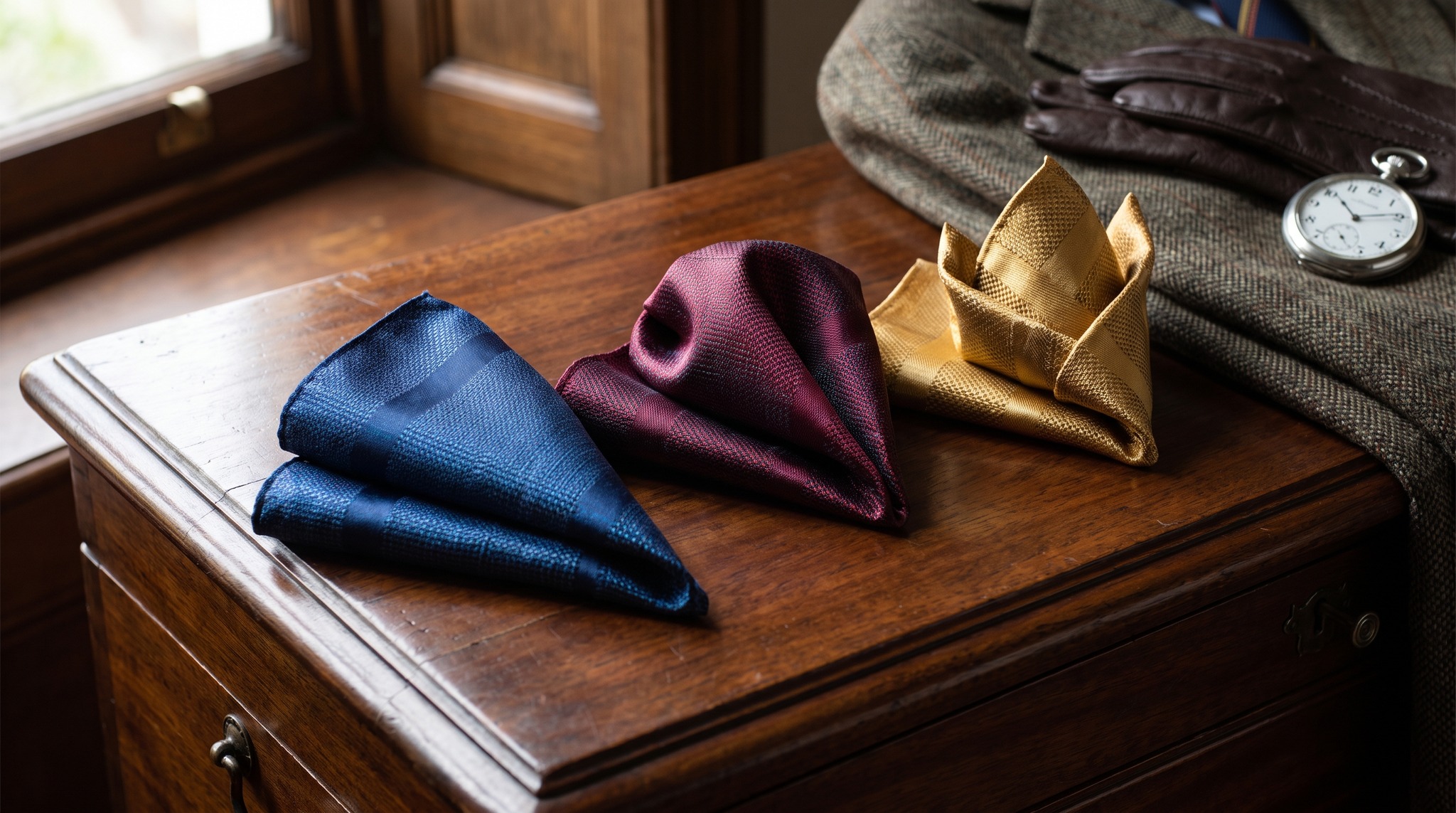
Folding a Pocket Square: Puff, Point or Straight Edge
You are wearing a jacket with a breast pocket and wondering which fold is right for your pocket square. Should the fabric billow loosely from the pocket as a puff, protrude with a sharp point, or finish with a precise edge? The choice of fold fundamentally changes the character of your appearance. Here you will learn which technique suits which occasion and how to execute each variation correctly.
The Puff: Casual Elegance Without Geometry
For the puff, grasp the square in the centre, let it fall loosely and tuck it hand first into the breast pocket. The result appears relaxed, almost accidental, although you deliberately arrange the fabric layers in the pocket. This fold is suitable for evening events, cocktail receptions and all occasions where you wish to demonstrate style awareness without stiffness. The puff works equally well with silk and linen, but requires a fabric that develops volume. Ensure that approximately two to three centimetres of fabric remain visible, no more.
The Point: Classic Precision for Formal Occasions
For the point fold, lay the square flat before you, fold it diagonally in half to form a triangle, and fold the two outer corners towards the centre. This creates a narrow shape with a point, which you insert into the pocket with the point facing upwards. The point protrudes approximately three to four centimetres and forms a clear vertical line. This fold suits jackets at business appointments, weddings or opera visits. It requires a fabric with body; cotton or firm linen are ideal.
The Straight Edge: Strict Order in the American Style
With the straight edge fold, you fold the square into a rectangle so that a straight horizontal line shows from the pocket. To do this, fold the square once lengthways, then across, until the width of the breast pocket is reached. The upper edge should lie approximately one centimetre above the pocket rim, parallel and exactly horizontal. This variation originates from the American business world and signals discipline. It works best with white linen or cotton and is worn primarily with dark suits. In Europe it is considered somewhat too formal, but in conservative industries it is accepted.
Fabric Choice and Pocket Format Determine the Effect
A pocket square classically measures 30 by 30 or 33 by 33 centimetres. Silk drapes more softly and is suitable for the puff; linen and cotton hold shapes better and are appropriate for the point or straight edge. The depth of the breast pocket determines how much fabric you can incorporate. With shallow pockets, as often found on zoot suit jackets, there is less scope, and the visible portion must sit all the more precisely. Try before the mirror to see which proportions suit your build and your jacket. The pocket square belongs among the Accessoires just as much as the tie and cufflinks; it completes the overall appearance.
Colour Coordination: Contrast or Tone on Tone
The pocket square may pick up a colour from the tie, shirt or suit, but should never match the tie exactly. A white square is always correct; coloured variations provide accents. If you choose patterned fabrics, ensure that the patterns do not clash: a polka dot square does not harmonise with a polka dot tie. Tone on tone appears restrained; contrasts create tension. With extravagant outfits you may work with bold colours; with business looks you are better advised to stay with muted tones.
Care: Ironing and Storage
Iron silk pocket squares on a low setting; linen tolerates higher temperatures. Store the squares lying flat, not folded, so that no permanent creases form. After each wearing you should allow the square to air before storing it again. Wash silk only by hand or at the dry cleaners; cotton and linen may go in the machine, but without fabric softener. A well maintained pocket square lasts for years and remains a reliable companion for every occasion where details matter.
Related items: Suits, Suits and jackets, baroque mirrors. The complete range: Menswear and Accessories.
All Il Padrino Moda news at a glance
Related categories: Suits, Suits and jackets, baroque mirrors. The full range: Men's Fashion and Accessories.
Read more: Having Pleats Sewn In: When Alterations Are Worth It, Baroque Armchairs for Statement Outfits: Furniture as a Stage, Earrings with High Collars: Style Rules for Gentlemen, How to Wear Slippers Properly: Style Rules With and Without Socks, Black, Gold, Bordeaux: Colours That Work on the Dance Floor