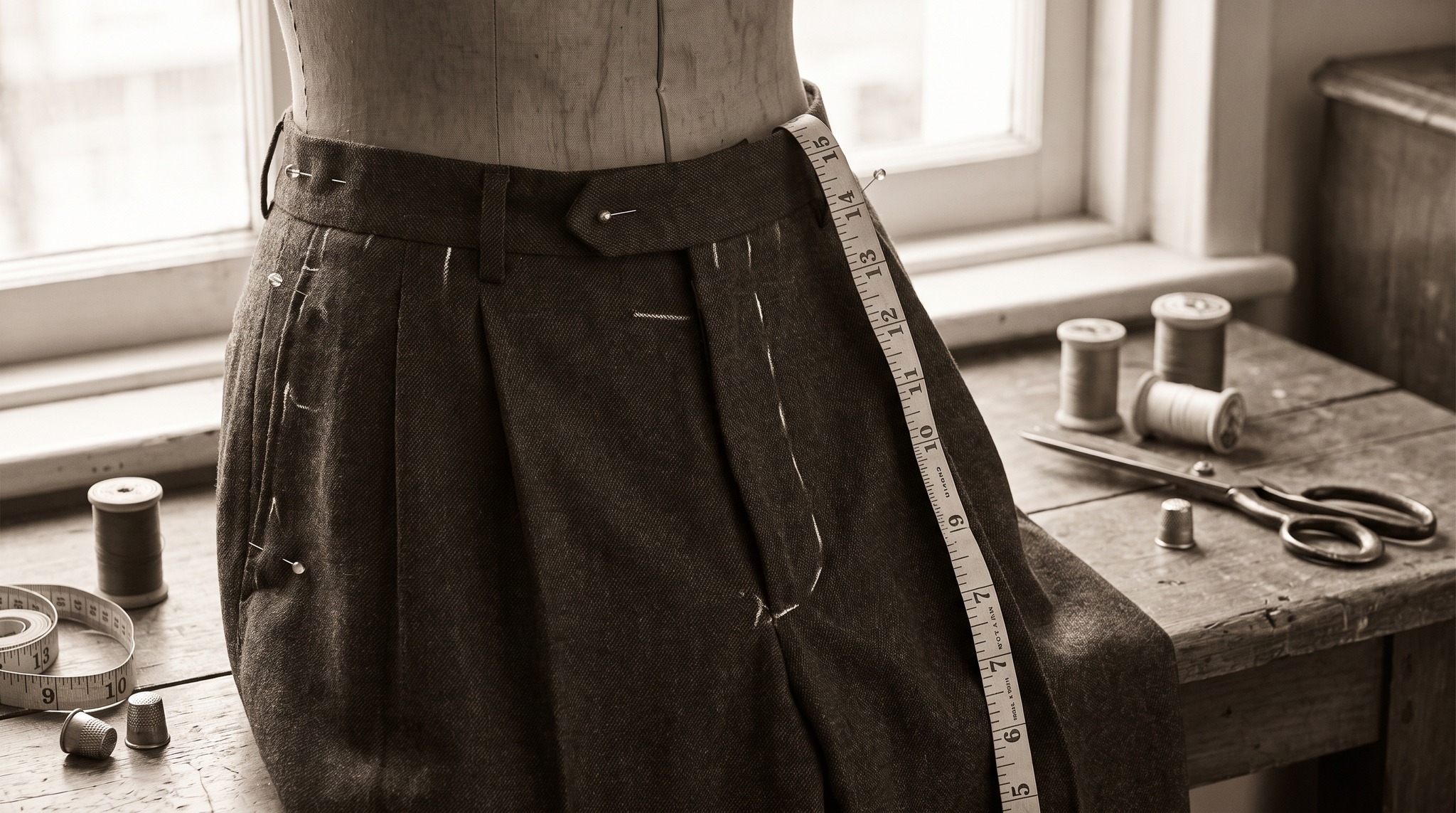
Having Pleats Sewn In: When Alterations Are Worth It
You own a classic pair of men's trousers without pleats and wonder whether a subsequent alteration is possible. Perhaps you have discovered the style of the 1920s and 1930s and wish to adapt your wardrobe accordingly. Or you appreciate the additional comfort that pleats provide. The question is: is the effort at the tailor worth it, or should you invest in a new model right away?
Technical Feasibility and Fabric Reserves
Sewing in pleats requires additional fabric in the hip area. You need at least 3 to 4 cm of extra width per pleat, so with two pleats per leg, that amounts to 12 to 16 cm total allowance. Flat-front trousers, however, are usually cut without this reserve. The tailor would have to completely unpick the waistband, open the side seams and check whether sufficient seam allowance is present. With industrially manufactured trousers, this allowance rarely exceeds 1.5 cm, which is insufficient for pleats.
Proportions and Silhouette
Pleats fundamentally alter the entire appearance of trousers. They create volume in the thigh and ensure a flowing drape of the fabric. An originally slim-cut pair of trousers loses its original proportion through subsequently sewn-in pleats. The leg width remains narrow whilst the hip area adds bulk. The result rarely appears harmonious. High-quality Pleated trousers are designed from the outset with corresponding leg width, typically 24 to 28 cm hem width with a 30 cm wide thigh section.
Cost in Relation to Result
A professional alteration of this kind costs between 80 and 150 euros, depending on the tailor and fabric quality. In addition, not every alterations tailor undertakes this work, as it is technically demanding and carries the risk of an unsatisfactory result. You are therefore investing a considerable sum in a pair of trousers that may never achieve the character of an original pleated cut. The waistband sits differently, the pleats do not fall naturally, and the overall silhouette remains a compromise.
When Alteration Makes Sense
There are exceptions: bespoke trousers or high-quality vintage pieces with generous seam allowances may be suitable for alteration. Likewise trousers made from heavy woollen fabrics weighing 350 to 400 grams per square metre, which offer sufficient substance for reworking. If the trousers already have a wide cut and only the pleats are missing, an experienced bespoke tailor can achieve a convincing result. Before making your decision, check whether at least 2 cm of seam allowance is present at the sides.
The Alternative: Targeted New Investment
In most cases, purchasing an authentic pair of pleated trousers directly leads to the better result. You receive a well-considered cut with correct waist width, appropriate leg length and harmonious overall proportion. Pay attention to details such as a rise of at least 32 cm, the position of the pleats approximately 4 cm beside the trouser seam and a leg width that matches the volume of the pleats. This way you wear a statement piece that fully unfolds its effect.
Related items: Belts, Cases and Bags, Luxury Slippers. The complete range: Men's Fashion and Accessories.
All Il Padrino Moda news at a glance
Related categories: Belts, Cases and Bags, Luxury Slippers. The full range: Men's Fashion and Accessories.
Read more: Baroque Armchairs for Statement Outfits: Furniture as a Stage, Jacket Sleeves: The Correct Shirt Cuff Under the Suit, Il Padrino: Why Authority Dresses Quietly, Made in Italy: How to Recognise Real Craftsmanship, Bag for the Shoot: What Photographer and Stylist Take Along