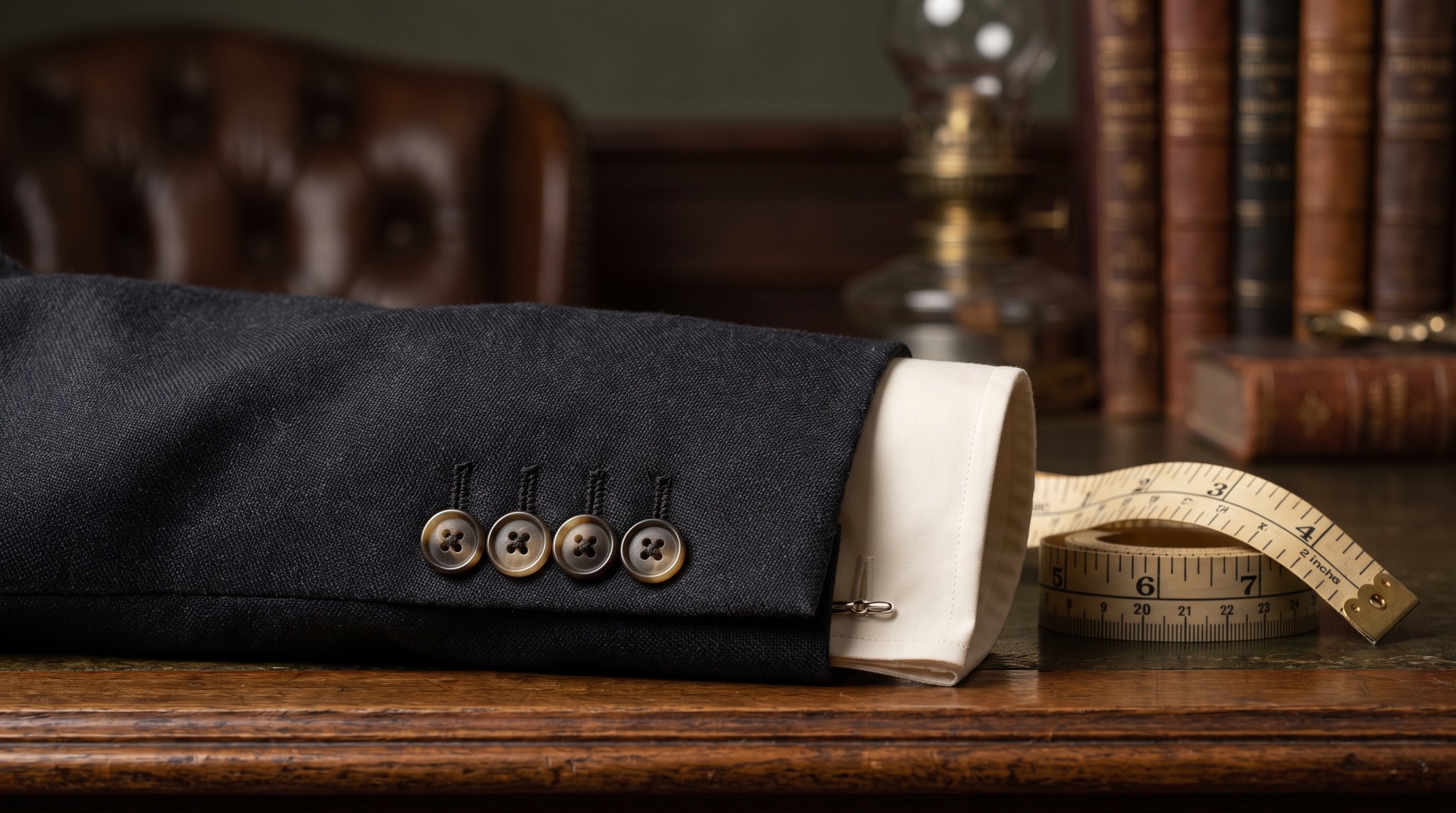
Jacket Sleeve End: Button Spacing and Cuff Length
You wear a jacket with functional sleeves and wonder whether the buttons are positioned correctly? Or you are having a jacket made and want to know how much shirt cuff should be visible? These details determine whether a jacket looks bespoke or off the rack. Those who wear statement pieces should know the subtleties at the sleeve end.
The Classic Button Spacing on Jacket Sleeves
On a traditional jacket, three to four buttons sit at the sleeve end. The distance between button centres is typically 1.5 to 2 centimetres. With extravagant cuts, such as in the zoot suit style, the spacing can increase to up to 2.5 centimetres to reflect the proportions of the wide cut. What matters is that the buttons do not appear crowded, but also that no gap emerges that visually stretches the sleeve end.
Functional Buttons and Their Significance
Genuine buttonholes on the sleeve, known as Milanese buttons, are a sign of high-quality workmanship. They allow the sleeve to be unbuttoned and turned back. This is not only a historical detail but also practical: at summer occasions or when dancing, it allows air to reach the wrist. Those who wear Suits and jackets with this feature demonstrate expertise.
The Correct Cuff Length Under the Jacket
About one to one and a half centimetres of shirt cuff should be visible at the wrist when the arm hangs relaxed. This rule applies regardless of jacket style. The cuff frames the wrist and prevents the jacket from resting directly on the skin. In movement-intensive situations, such as on stage or when swing dancing, the visible cuff may also be two centimetres, so that it does not disappear when the arm is bent.
Having Sleeve Length Measured Correctly
Sleeve length is measured from the shoulder seam to the wrist bone, with the arm slightly bent. A common mistake: the arm hangs completely straight during measurement, causing the jacket to sit too short later. Professional tailors have the elbow slightly bent and measure to the point where the wrist transitions into the hand. That is where the last button should sit, neither above nor below.
Proportions with Wide Cuts
With jackets featuring broad shoulders and wide drape, as worn in the 1920s, the sleeves often appear more voluminous. Here the button spacing should be adjusted accordingly to balance the proportions. A narrower spacing of 1.5 centimetres would visually compress the sleeve end. Instead, a spacing of 2 to 2.5 centimetres creates harmony with the generous cut of the jacket.
Details That Make the Difference
Besides button spacing and cuff length, button size also plays a role. Buttons with 18 to 20 millimetres diameter are standard, with extravagant pieces they may also be 22 millimetres. The material should match the rest of the wardrobe: mother of pearl for formal occasions, horn for more rustic looks. Ensure that the buttons lie flat and do not protrude, this is a sign of clean workmanship.
Related items: Luxury Slippers, Jewellery, Ladies Jewelry. The complete range: Menswear and Accessories.
All Il Padrino Moda news at a glance
Related categories: Luxury Slippers, Jewellery, Ladies Jewelry. The full range: Men's Fashion and Accessories.
Read more: Switching from Belt to Braces: Waistband Holes and Button Placement, Cap Fabric: Herringbone, Houndstooth or Chevron for Your Face Shape, Accessories as a Set: When Belt, Shoes and Bag Should Match, Engraving a Signet Ring: Initial, Coat of Arms or Symbol, Wool Cap in Rain: Waterproofing or Natural Drying