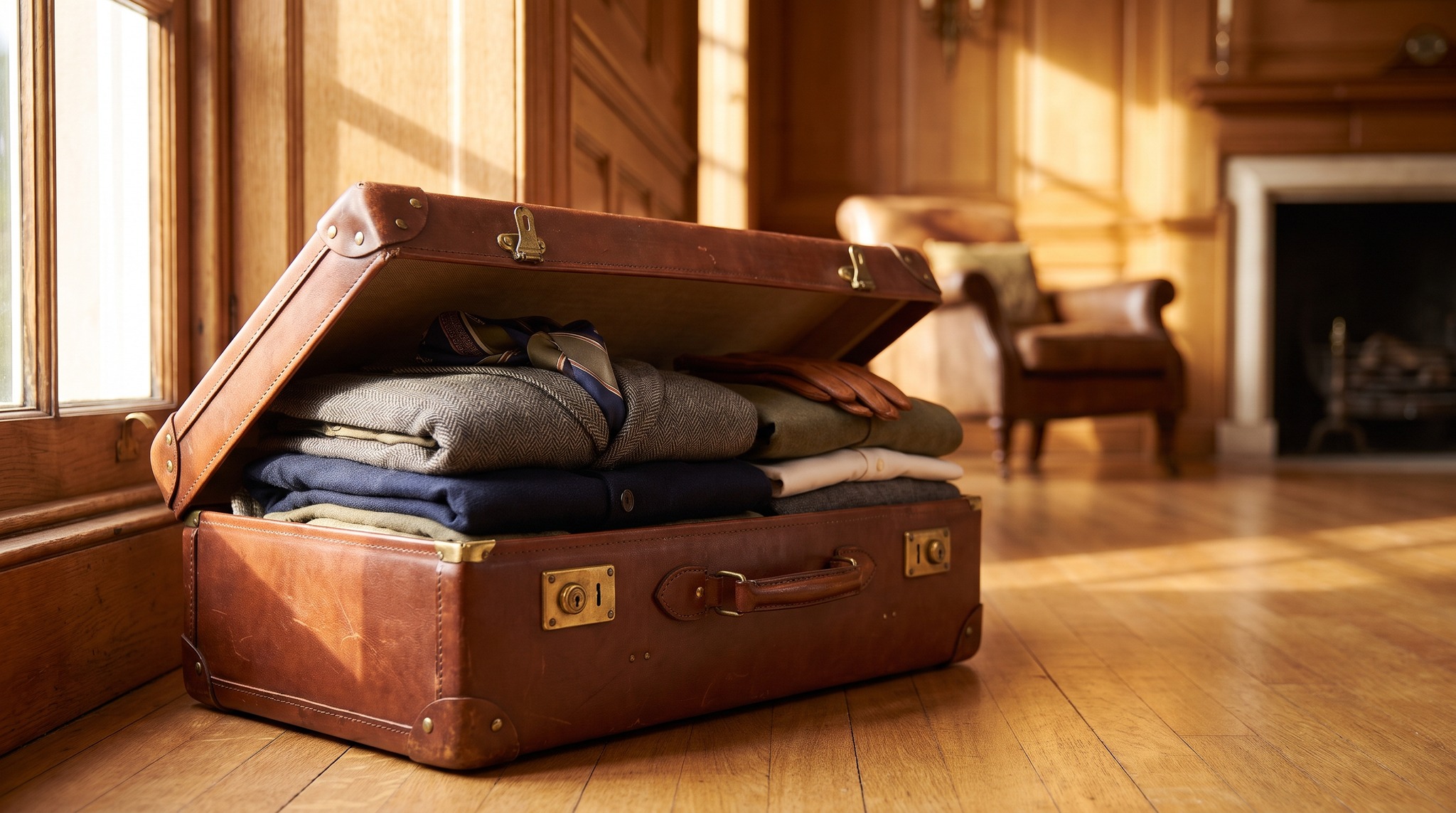
Luggage Weight: Planning Leather, Reinforcement and Contents Realistically
Anyone travelling with statement luggage will sooner or later ask themselves: how heavy will my leather suitcase actually be when I pack it? Particularly with classic hard-shell suitcases made of leather or artificial leather with metal reinforcements, the empty weight quickly adds up. Then there is the content: suits, shoes, accessories. To avoid unpleasant surprises at the airport and handle your luggage confidently, it is worth taking a realistic look at the figures.
Empty Weight: What Does the Empty Suitcase Weigh?
A classic hard-shell suitcase in cabin size with leather surface and metal corners weighs between 3.5 and 5 kilograms when empty. Larger models for checked luggage weigh between 5 and 7 kilograms. Material and workmanship are decisive: full-grain cowhide weighs more than embossed artificial leather, solid brass fittings more than chrome-plated steel. Suitcases with aluminium frames can add another 1 to 1.5 kilograms. Those who value durability should regard this weight as an investment in longevity.
Calculating Contents: Suits, Shoes and Accessories
A complete suit made of virgin wool weighs approximately 1.2 to 1.8 kilograms, depending on fabric weight and workmanship. A pair of welted leather slippers weighs 600 to 800 grams, Derby shoes with double soles can also reach 900 grams. Shirts weigh 200 to 300 grams each, silk ties 50 grams. For a three-day trip, you should reckon with 4 to 6 kilograms of contents, for a week rather 8 to 10 kilograms. These figures help to calculate the total weight in advance.
Airlines: Know and Observe Limits
Most airlines allow 8 kilograms for economy hand luggage, some only 7. Checked luggage is usually allowed to weigh 20 to 23 kilograms, in business class often 32 kilograms. If your leather suitcase already weighs 5 kilograms empty, only 3 kilograms remain for the contents in hand luggage. That is enough for a suit, a shirt and accessories, nothing more. Therefore plan precisely what you really need, and weigh in advance at home if in doubt.
Optimising Distribution and Carrying Comfort
Heavy items belong at the bottom and close to the wheels or handle. This keeps the centre of gravity stable, and you need to exert less force when carrying. You can stuff shoes with socks or accessories to save space. Place suits folded lengthwise on top so that the fabric does not crease. A well-packed suitcase feels lighter, even if the scales show the same weight. Those who regularly travel with high-quality luggage quickly develop a feeling for the right balance.
Material and Care: Weight in View Long-Term
Leather can gain weight through moisture if it is not properly cared for. Regular conditioning keeps the material supple and prevents it from absorbing water. You should keep metal fittings dry and occasionally polish them with a soft cloth. This keeps the empty weight constant, and your suitcase retains its shape for years. In the category Cases and Bags you will find models that are designed for longevity and whose weight is justified by solid workmanship.
Rule of Thumb for Travel Planning
As a guide: empty weight plus contents should not exceed 80 per cent of the permitted limit. This gives you a buffer for souvenirs or spontaneous purchases. Those who travel frequently invest in a digital luggage scale. It weighs accurately to 50 grams and fits in any jacket pocket. This avoids discussions at check-in and allows you to travel relaxed. Good luggage is not ballast, but part of your appearance.
Related: Caps, Belts, Luxury Slippers. The complete range: Menswear and Accessories.
All Il Padrino Moda news at a glance
Related categories: Caps, Belts, Luxury Slippers. The full range: Men's Fashion and Accessories.
Read more: Cap Fit: Adjusting Head Shape, Brim Angle and Fit, Suit Sleeve: Coordinating Button Spacing and Cuff Show Correctly, Belt with Pleated Trousers: Buckle Centred or Offset to the Side, Jacket Lining: Smooth, Patterned or Contrasting Colours, Shortening Pleated Trousers: Cuff or No Cuff