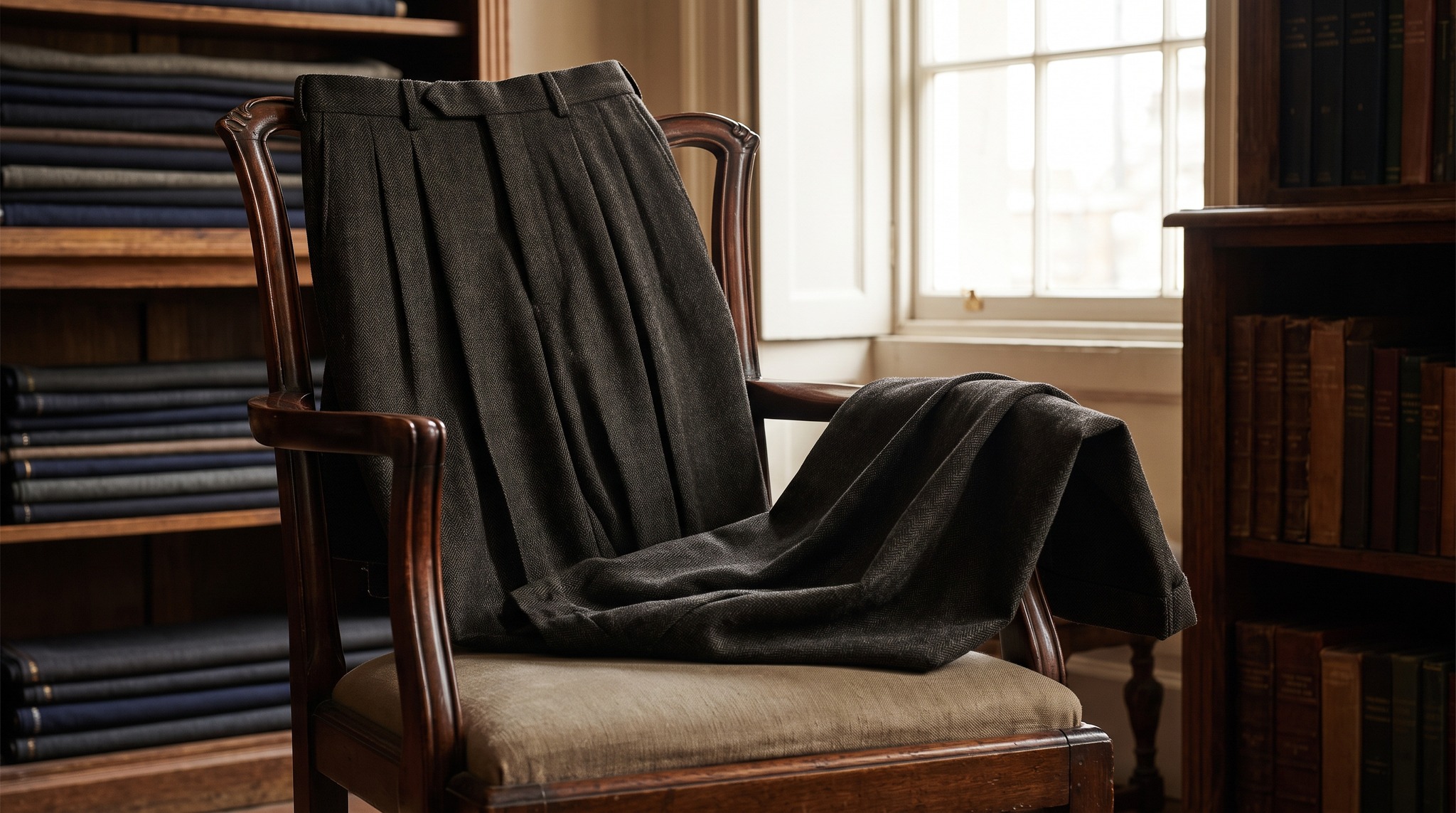
Pleated Trousers When Seated: Pleat and Leg Width with Bent Knee
You wear pleated trousers and wonder why the fabric pulls at the thigh or the pleat shifts as soon as you sit down? The sitting test is the toughest challenge for any trouser with front pleats. While the pleat falls elegantly downward when standing, bending the knee reveals whether the cut and width truly fit. Those who wear statement pieces want a flawless silhouette even when seated.
Why the Front Pleat Shifts When Sitting
As soon as you sit down, the fabric at the thigh shifts upward and to the side. The front pleat, which runs centrally or slightly offset when standing, rotates outward or opens up. This is not a defect but physics: the angle at the knee joint shortens the front of the leg while the back is stretched. Trousers that are too narrow press the pleat flat, while those too wide let it spring open uncontrollably. The decisive factor is the thigh width in combination with the rise height.
Reference Values for Leg Width and Pleat Depth
Classic pleated trousers should offer at least 8 to 10 centimetres of additional width at the widest point of the thigh compared to the leg circumference. With a pleat depth of 3 to 4 centimetres per side, this provides enough room for the pleat not to disappear completely when sitting. The rise should ideally sit 3 to 4 centimetres above the hip bone, preventing the waistband from slipping into the groin. Those who sit regularly should choose a hem width of 32 centimetres rather than 28 centimetres.
How the Pleat Behaves When Seated
Ideally, the front pleat opens by 1 to 2 centimetres when sitting down but remains visible as a line. The fabric drapes in soft waves over the knee without pulling or creating horizontal creases. In high-quality Pleated trousers, the construction ensures that the pleat immediately returns to position after standing up. Stiffer fabrics above 350 g/m² retain sitting creases longer, while lighter wool blends between 240 and 280 g/m² smooth out more quickly.
Coordinating Leg Width and Freedom of Movement
A leg width of 30 centimetres at the hem allows relaxed sitting without the fabric riding up the lower leg. Those who stand and walk frequently on stage or in clubs can choose a narrower cut. For dancers or doormen who alternate between standing and sitting, greater width is more comfortable. The pleat should never be deeper than 4 centimetres, otherwise the fabric bunches unfavourably when bending the knee.
Care and Pressed Crease After Wearing
After prolonged sitting, hang the trousers overnight on a hanger with clips at the hem. Gravity smooths out light sitting creases on its own. Wool fabrics recover better than cotton or linen. Press the front pleat from inside to outside, place the iron centrally on the pleat and draw it downward in one motion. Steam fixes the line without hardening the fabric. This keeps the silhouette flawless even after many appearances.
Related items: Belts, Cases and Bags, Luxury Slippers. The complete range: Menswear and Accessories.
All Il Padrino Moda news at a glance
Related categories: Belts, Cases and Bags, Luxury Slippers. The full range: Men's Fashion and Accessories.
Read more: Lengthening Suit Sleeves: Checking Seam Allowance and Adjusting Lining, Women's Jewellery for Men's Wardrobes: Adjusting Chain Thickness and Length, The Cap with a Blazer: When the Clash Works, Rings for Men and Women: Shape, Size, Effect, From the Ballroom to the Screen: The History of the Zoot Suit