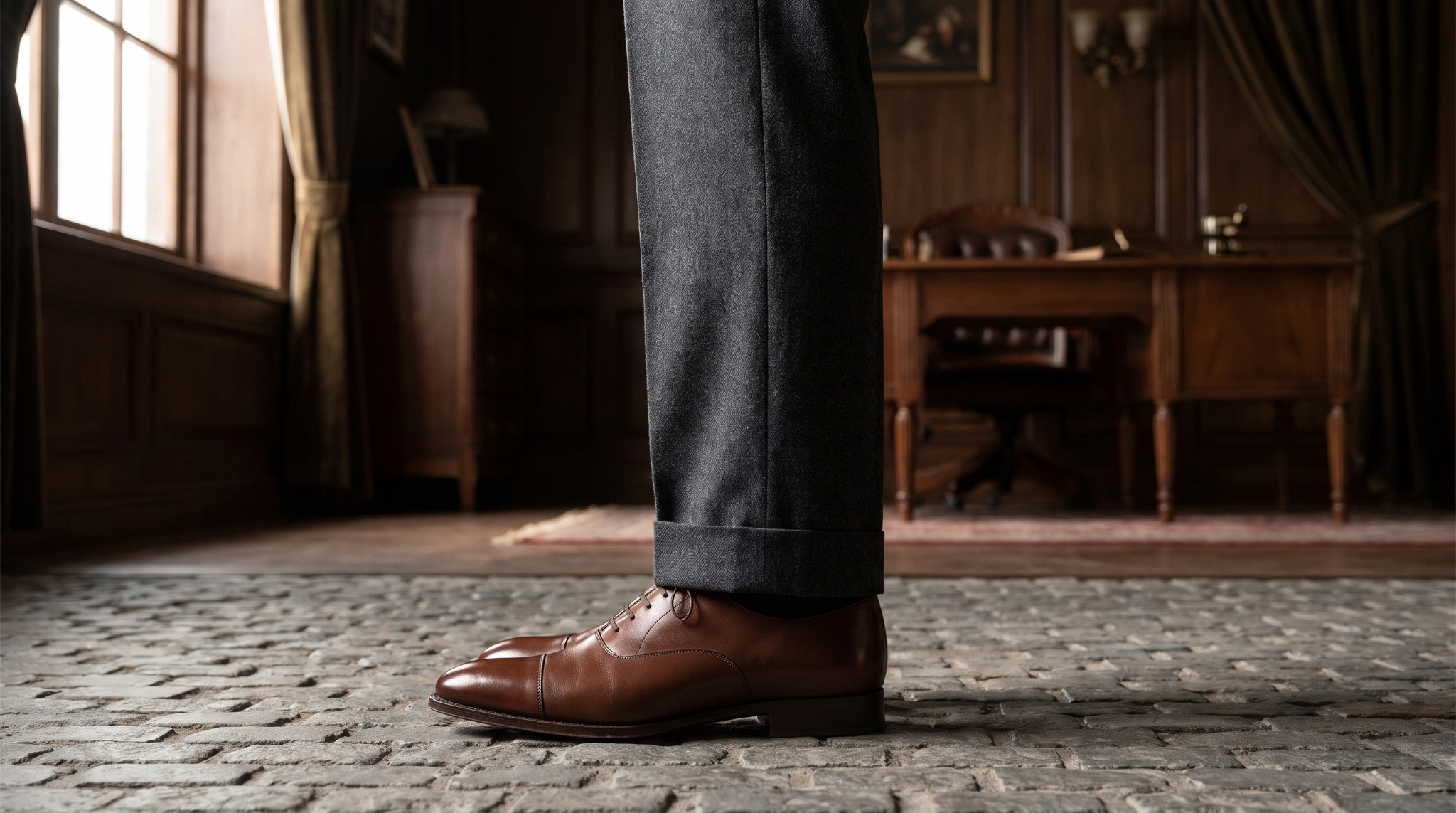
Pleated Trousers Without Cuffs: Determining Hem Length and Shoe Contact
You wear your pleated trousers without cuffs and wonder where exactly the hem should end? Unlike trousers with cuffs, there is no fixed finish that visually defines the length. Instead, the hem length determines whether your trousers fall elegantly over the shoe or end just above it in a modern way. The correct length depends on the cut of the trousers, the shoe shape and your personal style.
The Classic Shoe Contact: Slight Break at the Instep
With classic Pleated trousers, the hem traditionally ends so that it lightly touches the instep when standing and creates a subtle fold. This so-called break ensures that no bare ankle is visible when walking. The hem rests on the shoe approximately 1 to 1.5 centimetres above the heel edge. This length works particularly well with wide-cut trousers with a high waist, as it does not interrupt the vertical line and allows the fabric to fall elegantly.
Modern Variation: Hem Just Above the Shoe
Those who prefer a more contemporary look choose a shorter hem length without a break. The trouser hem ends just above the instep, so that no fabric rests on it when standing. This variation emphasises the shoe more strongly and appears more dynamic. It is particularly suitable for slimmer pleated trousers and statement loafers. When walking, a piece of ankle or sock is then deliberately visible, which underlines the extravagant character.
Consider Shoe Shape: Heel Height and Upper Form
The heel height of your shoe significantly influences the ideal hem length. A loafer with a flat heel requires a different length than a shoe with a three-centimetre heel. Therefore, always measure the hem length with the shoes you will wear with the trousers. For shoes with a high upper or striking details, the hem should fall rather shorter so that the shoe shape comes into its own. Flat, plain loafers, on the other hand, can also tolerate a classic break.
Practical Rule of Thumb for Fitting
This approach helps determine the optimal hem length:
- Stand upright, weight evenly distributed, wearing the appropriate shoes
- The hem should fall approximately half a centimetre lower at the back than at the front
- For classic length: at the front, the hem touches the instep, at the back it reaches the upper heel edge
- For modern length: at the front, the hem ends one centimetre above the instep, at the back just above the heel base
- Take a few steps: the hem must not slip under the sole
Fabric and Drape Influence the Effect
Heavy fabrics with high weight drape differently than light summer wools. A dense fabric weighing 350 grams per square metre hangs more tautly and tolerates a somewhat more generous length. Lighter fabrics weighing 240 grams tend to move more, which is why a shorter length often appears more advantageous here. The leg width also plays a role: very wide cuts in the zoot suit style tolerate more fabric at the hem, while moderate widths should be more precisely tailored.
Related items: Belts, Cases and Bags, Luxury Slippers. The complete range: Menswear and Accessories.
All Il Padrino Moda news at a glance
Related categories: Belts, Cases and Bags, Luxury Slippers. The full range: Men's Fashion and Accessories.
Read more: Suit Breast Pocket: Depth, Width and Angle for Pocket Squares, Layering Men's Jewelry: Wearing Multiple Chains in Different Lengths, Caring for Your Wardrobe: Ironing, Airing and Storage of Menswear, The Right Bag for Every Occasion: Evening Wear and Travel, Braces or Belt: What Suits High Pleated Trousers