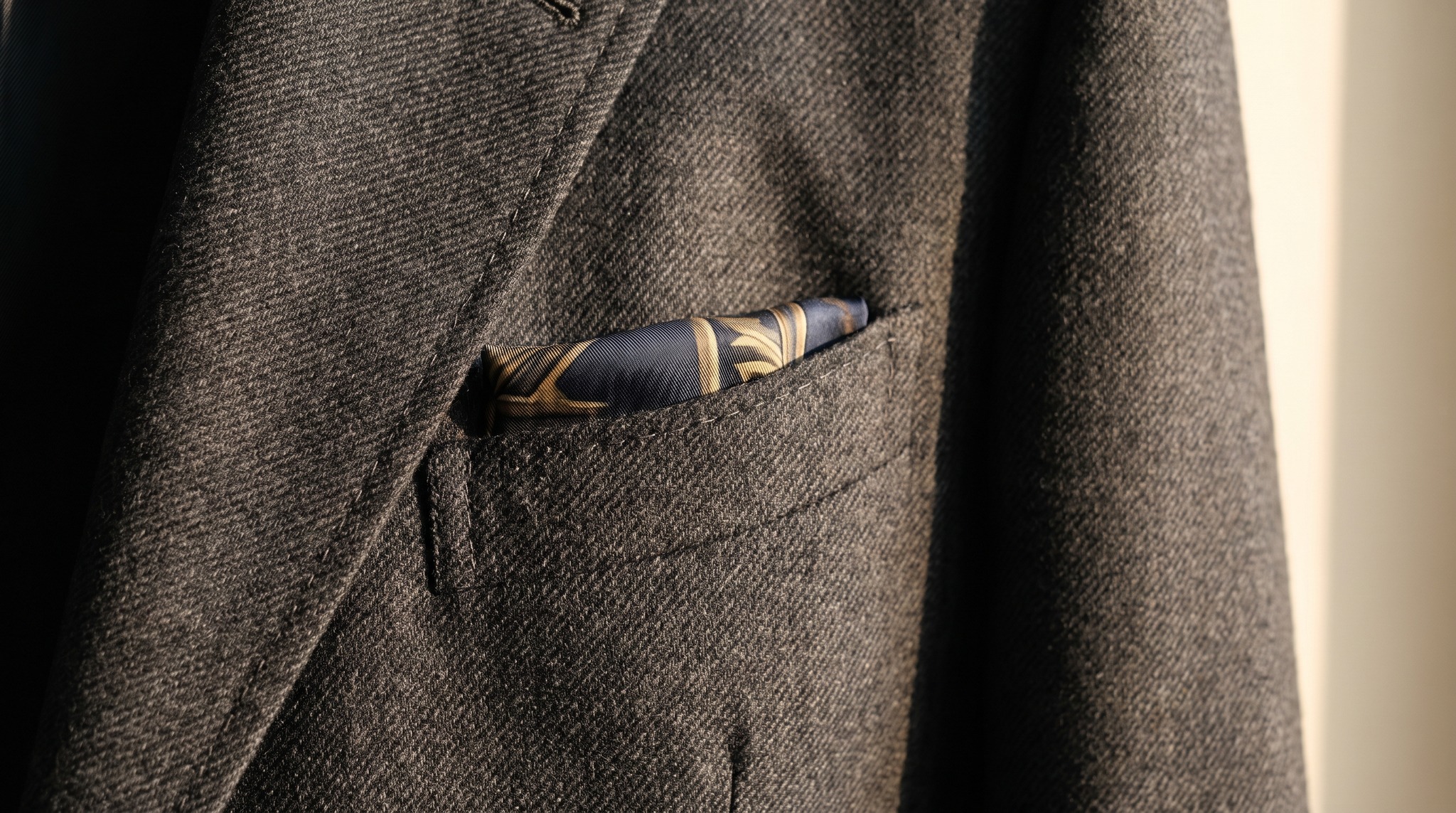
Suit Breast Pocket: Size and Position for Pocket Square
You wear a pocket square and wonder whether your jacket's breast pocket is the right size? Or you want to know exactly where the welt pocket should sit so that the square displays perfectly? The position and depth of the breast pocket determine how much fabric remains visible and whether the arrangement holds all day. Here you will learn which dimensions and placement have proven successful.
Standard Dimensions of the Breast Pocket
The classic welt pocket measures between 11 and 13 centimetres in width, with a depth of 14 to 16 centimetres. These proportions allow a folded pocket square to be placed so that approximately 3 to 4 centimetres of fabric remain visible above the pocket edge. Pockets that are too shallow let the square slip, those too deep swallow the fold. High-quality jackets often feature an additional inner seam that secures the square and prevents slipping.
Position on the Chest
The breast pocket ideally sits 8 to 10 centimetres below the lapel notch and approximately at the height of the third button row, measured from the top. Horizontally, it lies centrally between the shoulder seam and chest centre, slightly offset outwards. This placement ensures that the pocket square remains in the field of vision without competing with tie or bow tie. With extravagant cuts, as shown by Suits and jackets in the style of the 1920s, the pocket may sit minimally higher to emphasise the wide lapels.
Depth and Interior Construction
Not only the outer opening is decisive, but also the interior construction. A well-constructed breast pocket features a base of firm cotton fabric or linen that supports the pocket square. Some tailors sew in an additional bar that divides the pocket into two chambers. This keeps the square in position even when you move or remove the jacket. The depth should be at least one and a half times the visible square fold, so that sufficient material disappears into the pocket.
Adaptation to Fabric Weight and Fold
Heavy silk squares or multi-layered linen pocket squares require a somewhat wider pocket opening so that the fabric does not bunch. Light cotton or silk twill, however, falls into narrow pockets without difficulty. For the classic triangle fold, a depth of 14 centimetres suffices, the puff variant requires rather 16 centimetres. Ensure that the welt is cleanly finished: untidy seams crease the fabric and make the arrangement appear careless.
Rules of Thumb for Practice
- Pocket width: 11 to 13 centimetres for standard pocket squares
- Pocket depth: 14 to 16 centimetres, depending on fold
- Visible square surface: 3 to 4 centimetres above the pocket edge
- Position vertical: 8 to 10 centimetres below the lapel notch
- Position horizontal: centrally between shoulder and chest centre
Check During Fitting
Test the breast pocket by inserting a folded pocket square and raising both arms. If the square slips downwards or tilts to the side, the pocket is too wide or poorly secured. A well-fitting square remains in shape even after hours. Also check whether the pocket opening runs parallel to the ground: diagonally sewn welts make even perfectly folded squares appear crooked.
Related items: Luxury Slippers, Jewellery, Ladies Jewelry. The complete range: Menswear and Accessories.
All Il Padrino Moda news at a glance
Related categories: Luxury Slippers, Jewellery, Ladies Jewelry. The full range: Men's Fashion and Accessories.
Read more: Testing Suitcase Handles: Checking Carrying Comfort at Full Weight, Rubber Stopper for Leather Soles: Function and Use with Slippers, Slipper Insole: Leather, Cushioning or Footbed Compared, Suit Lapels: Peaked, Notch or Shawl Collar for Your Build, Slipper Colour: Black, Brown or Burgundy with Trousers