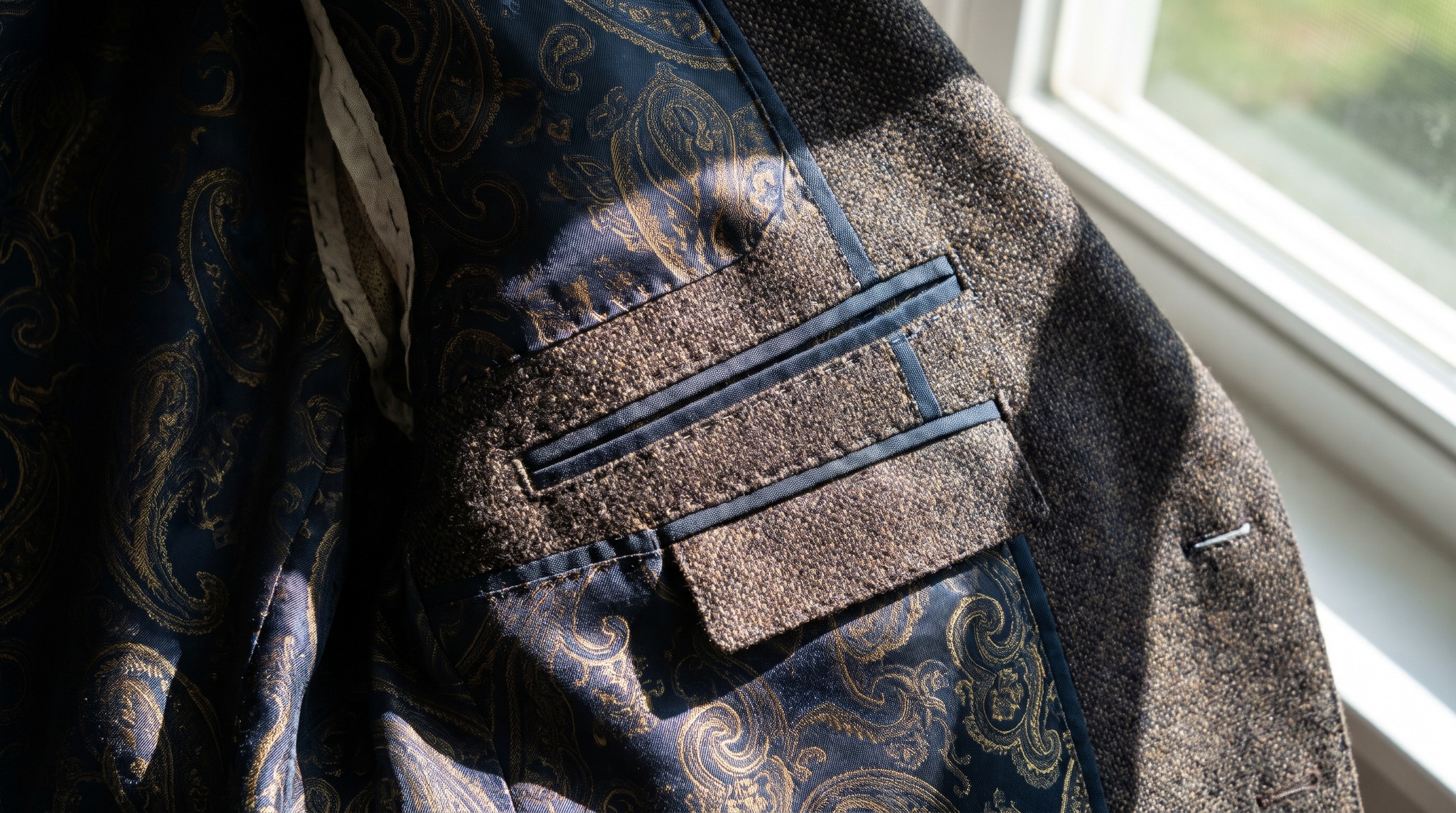
Suit Inner Pocket: Position, Size and Zip Fastener
Anyone wearing a high-quality suit uses it not merely as a shell, but as a functional statement. The inner pocket plays a central role in this: it stores wallet, smartphone or business cards discreetly on the body without disturbing the silhouette. But where exactly should it ideally sit, which dimensions are practical and when is a zip fastener worthwhile? These questions determine comfort and elegance in everyday life.
Position of the Inner Pocket in the Jacket
The classic inner pocket is located on the left breast side, approximately at heart level, accessible through a vertical or slightly diagonal opening. This placement enables quick access with the right hand without having to open the jacket. High-quality Suits often feature a second inner pocket on the right side, positioned lower, for documents or a slim notepad. In wide-cut zoot suit jackets, the pocket may sit somewhat lower to accommodate the generous fit.
Ideal Size for Practical Use
A standard inner pocket measures approximately 18 to 20 centimetres in width and 15 to 17 centimetres in depth. This is sufficient for a folded smartphone, a slim wallet or a passport. Pockets that are too shallow allow items to slip out, while those that are too deep bulge and disturb the line of the jacket. Anyone regularly transporting larger objects should look for an additional pocket in the lower lining, which some tailors incorporate as an option.
Zip Fastener or Open Design
The open inner pocket is the classic choice: quickly accessible, discreet, without additional weight. A zip fastener, however, offers security during movement, when travelling or in dense crowds. It prevents valuables from slipping out when bending down or dancing. However, an inferior zip fastener can damage the lining or snag. Anyone who values functionality chooses a flat, concealed metal zip fastener that opens smoothly.
Material and Construction of the Pocket
The inner lining of a good jacket consists of viscose, cupro or silk. The pocket itself should be double-stitched, with reinforced corners, to prevent tearing. An additional leather trim at the pocket opening protects against abrasion from keys or coins. In extravagant Suits in the style of the 1920s, one occasionally finds contrasting lining fabrics that also make the inner pocket a detail.
Care and Repair of the Inner Pocket
A torn inner pocket can usually be renewed by the tailor without difficulty. It is important to empty the pocket regularly so that no sharp-edged objects press permanently into the lining. Heavy objects such as bunches of keys do not belong in the jacket; they distort the fabric and strain the seam. Anyone storing their jacket for an extended period should brush out the inner pockets to remove dust and lint, which attack the fabric over time.
Related items: Accessoires, Caps, Belts. The complete range: Menswear and Accessories.
All Il Padrino Moda news at a glance
Related categories: Accessoires, Caps, Belts. The full range: Men's Fashion and Accessories.
Read more: Suit Trouser Waistband Height: Where the Waistband Sits Relative to the Waist and Jacket, Pleated Trousers Without Cuffs: Determining Hem Length and Shoe Contact, Slipper care after rain: drying, preserving shape, nourishing leather, Belt Colour for Multi-Coloured Shoes: Choosing Main Tone or Accent, Wearing Pleated Trousers Without a Belt: Waistband Width and Fit