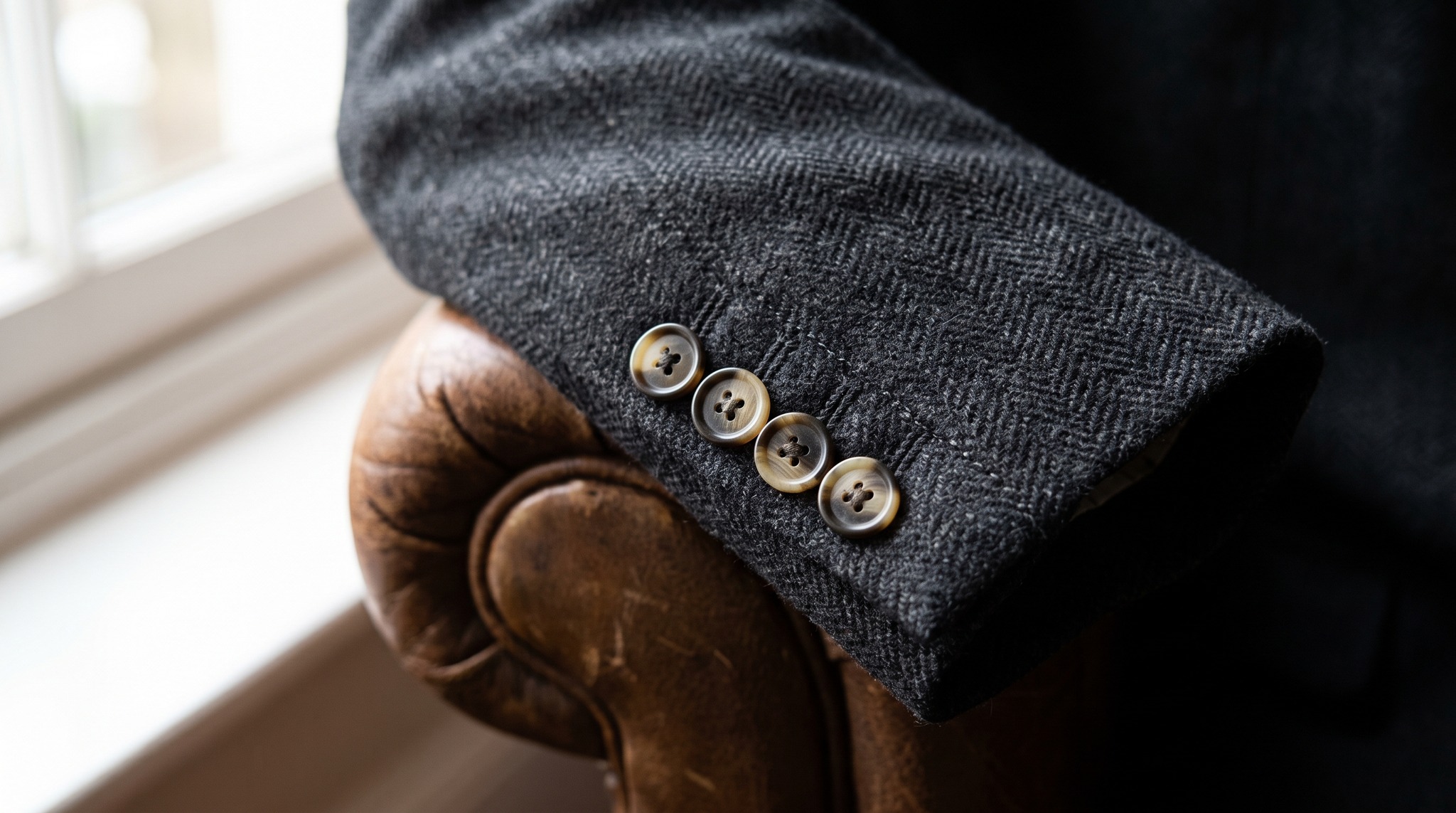
Suit Sleeve Buttons: Functional or Merely Sewn On
You have chosen a suit and are now examining the buttons on the sleeve. Can they actually be opened, or are they firmly sewn on? This question concerns many wearers of statement pieces, as the answer reveals more about quality and craftsmanship than one might initially suspect. Functional sleeve buttons are considered a sign of bespoke tailoring or high-quality ready-to-wear, while sewn-on buttons are standard in industrially manufactured pieces. We will show you how to recognise the difference and what it means.
The Difference Between Real and False Buttonholes
Sewn-on buttons sit on a closed sleeve finish, with buttonholes merely suggested or absent altogether. Functional buttons, however, pass through genuine, hand-sewn buttonholes and can be opened. These so-called surgeon's cuffs make it possible to roll up the sleeve without stretching the fabric. In classic menswear of the 1920s, functional sleeve buttons were a privilege of bespoke tailoring. Today they signal attention to detail and artisanal precision.
Why Some Sleeves Cannot Be Altered
With sewn-on buttons, sleeve length can be shortened or lengthened without difficulty, as the hem is not yet finally closed. Once real buttonholes have been worked in, their position is fixed. Subsequent alteration of sleeve length then becomes laborious or impossible without relocating the button placket. For this reason, functional buttons are only attached after precise fitting and length adjustment. Anyone choosing Suits with this detail should have the fit carefully checked beforehand.
How Many Buttons Belong on the Sleeve
The number of sleeve buttons follows conventions established over decades. Classic business suits usually feature four buttons, sports jackets often three, formal evening suits sometimes only two. In the zoot suit tradition of the 1920s and 1940s, one also finds extravagant variants with five or six buttons emphasising the wide sleeve finish. What matters is the overall appearance: wide lapels and broadly cut shoulders can accommodate more buttons, whilst slimmer silhouettes appear more harmonious with three or four.
Kissing Buttons: When the Buttons Touch
A particular variant is kissing buttons, where the buttons are set so closely that they slightly overlap or touch. This arrangement was long considered a hallmark of Neapolitan tailoring and is now found on many high-quality Suits and jackets. The effect is subtle yet striking: the sleeve section appears more compact and elegant. Whether the buttons actually touch or are set a few millimetres apart often remains a matter of taste for the wearer or tailor.
Care and Handling of Functional Sleeve Buttons
Real buttonholes require some attention during cleaning. Dry cleaning can stress the buttonhole stitching, particularly when hand-sewn. Before handing in your garment, check that all buttons are secure and the holes are cleanly finished. When ironing, you should smooth the sleeve section on a sleeve board to avoid damaging the buttons. Open the buttons occasionally so that the buttonholes remain supple and do not stick together. This way you preserve the functionality and characteristic detail of your suit for years to come.
Related items: Men's Jewelry, baroque mirrors, Pleated trousers. The complete range: Menswear and Accessories.
All Il Padrino Moda news at a glance
Related categories: Men's Jewelry, baroque mirrors, Pleated trousers. The full range: Men's Fashion and Accessories.
Read more: Trouser Cuffs: Choosing the Right Width and Height for Your Shoes, Replacing Cap Lining: Renewing Sweatband and Inner Fabric, The Zoot Suit: Why the Long Jacket Changes Every Room, Giving Women's Jewellery: Check Size, Style, Wearability, Brooch for Men: Size, Position, Occasion