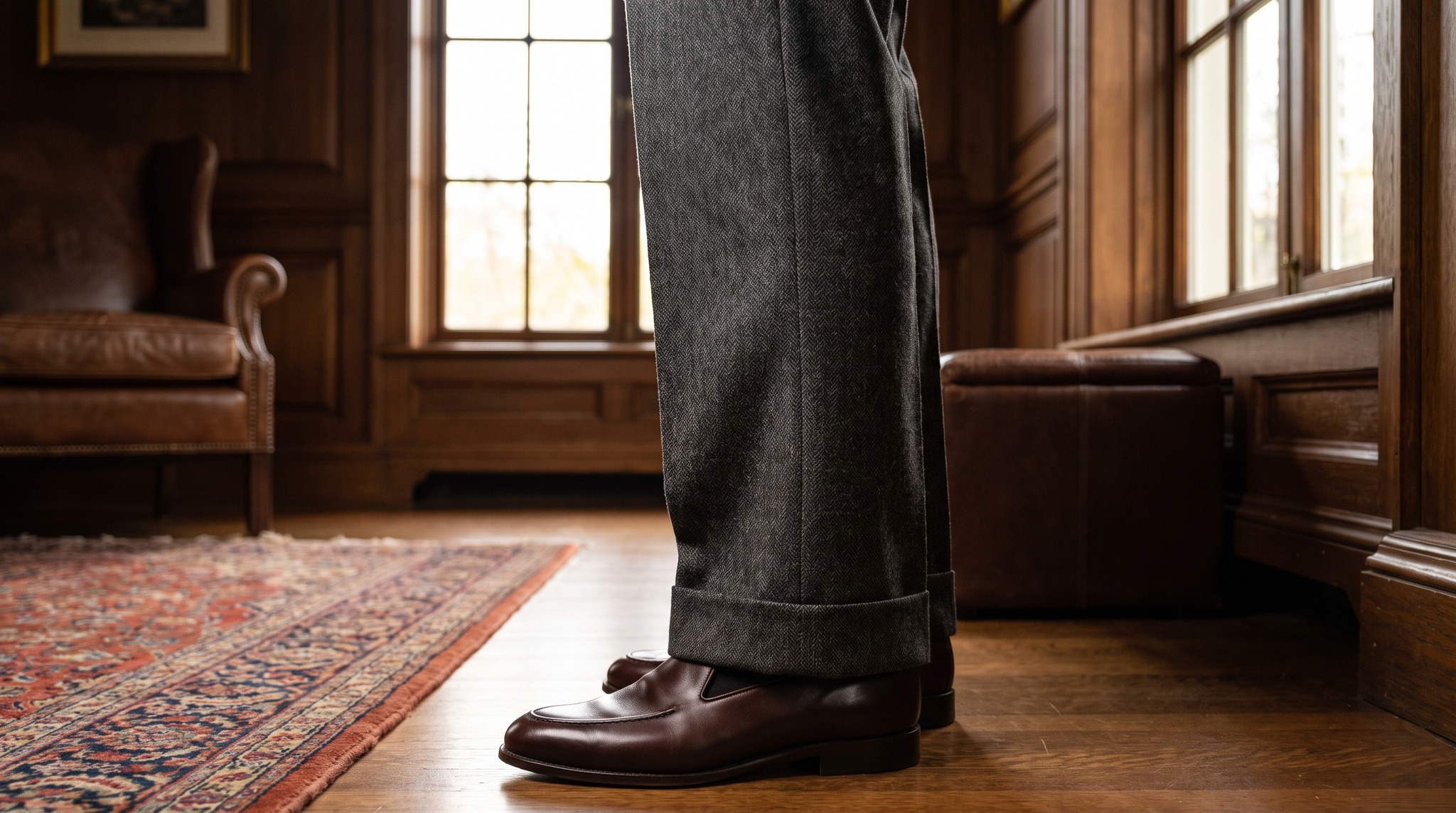
Trouser Cuffs: Width and Height to Match the Shoe
The trouser cuff is more than a detail. It alters proportions, influences the drape of the fabric, and must match the shoe. Those who wear statement pieces know the effect: a cuff that is too narrow looks lost, one that is too wide overwhelms the silhouette. The question is therefore: which width and height harmonize with which type of shoe, and when is it better to forgo the turn-up altogether?
The Classic Rule of Thumb for Cuff Widths
The width of the cuff is determined by the cut of the trousers and the shape of the shoe. As a basic rule: the cuff should be approximately half the leg width at the hem, but at least 4 cm and at most 5.5 cm. For wide-cut pleated trousers with a 24 cm hem width, 4.5 to 5 cm is ideal. Narrower trousers can accommodate 4 cm; anything less appears indecisive. A wide cuff requires a shoe with volume: full brogue, Budapest, or a classic loafer with a substantial sole.
Shoe Height and Shaft Shape Determine Cuff Height
The height of the cuff, meaning how far the trousers end above the shoe, follows a simple rule: the hem should rest on the instep without bunching. With low-cut loafers or monks, the trousers may break slightly; with high lace-up shoes or ankle boots, they end just above the lacing. A cuff that sits too high makes the calf appear shorter. A cuff that hangs too low conceals the shoe and robs the outfit of clarity. The balance usually lies at 2 to 3 cm distance between the cuff edge and the upper edge of the shoe.
Which Shoes Require a Cuff
Substantial, classic shoes benefit from the cuff: Budapests, full brogues, derby models with double soles, robust penny loafers. The cuff gives these shoes space, emphasizes their presence, and creates a clear horizontal line. Even with Suits in the zoot style, which work with broad shoulders and a high waist, the cuff belongs to the formal language. It reinforces the proportion, makes the legs appear longer, and sets a deliberate endpoint. Without a cuff, such combinations appear unfinished.
When the Cuff Is Omitted
Narrow, elegant shoes such as wholecuts, oxfords with a slender last, or delicate loafers do not accommodate a cuff. Here the additional fabric layer disrupts the line. Dinner jackets and very formal occasions also call for trousers without a turn-up. This also applies to trousers with very narrow leg widths: below 20 cm hem width, a cuff appears contrived. In these cases, the trousers end just above the heel, with minimal break or completely smooth.
Cuff Width and Fabric Weight
Heavy fabrics from 320 g/m² upwards carry a wide cuff without difficulty. Light fabrics under 240 g/m² tend to cause the cuff to bulge or appear limp. Here either a narrower cuff of 4 cm is advisable, or omission altogether. With Pleated trousers with a high waist and wide leg, the cuff belongs to the construction: it weights the hem, allows the fabric to fall straight, and prevents the trousers from riding up. Without a cuff, the trousers lose structure.
Care and Durability of the Cuff
The cuff collects dust, moisture, and dirt. Regular shaking out and occasional brushing extend its lifespan. During cleaning, the cuff should be unfolded so that no residue becomes embedded. A well-made cuff is finished on the inside, the edge cleanly topstitched. Poor workmanship shows immediately: frayed seams, uneven width, missing fixation. A cuff is not a concession, but a mark of quality.
Related items: baroque mirrors, Accessoires, Caps. The complete range: menswear and accessories.
All Il Padrino Moda news at a glance
Related categories: baroque mirrors, Accessoires, Caps. The full range: Men's Fashion and Accessories.
Read more: Replacing Cap Lining: Renewing Sweatband and Inner Fabric, Giving Women's Jewellery: Check Size, Style, Wearability, Cap Brim: Length and Curvature for Your Face Shape, Slipper Insole: Leather, Cushioning or Footbed Compared, Suit Lapels: Peaked, Notch or Shawl Collar for Your Build